2.4 编写 tile kernel
来源:《CUDA Programming Guide》13.4.2,书内第 74–104 页相关内容。正文为中文,常用 CUDA 与 memory 术语保留英文;代码保留原文,恢复 PDF 断行与缩进。
CUDA Tile 提供不同于 SIMT 的 GPU kernel 编程方式。程序员以 tile 为单位表达并行性,将底层 thread 并行化交给编译器和内置操作,从而更容易使用 Tensor Memory Accelerator(TMA)、Tensor Core 等 GPU 性能特性。
- Python 通过 cuTile Python 包
cuda.tile使用 CUDA Tile。 - CUDA Tile C++ 从 CUDA Toolkit 13.3 开始提供。
kernel 外围的应用程序代码,例如分配 device memory、host/device 传输及安排 launch 顺序,与前面 SIMT 示例相同。tile kernel 使用标准 CUDA API 分配的 global memory,结果也以相同方式复制回 host。改变的是 kernel 内部的编程方式。
SIMT 中,程序员计算每个 thread 的全局索引,加载其数据、计算并写回。Tile 中,程序员站在整个 block 的层面:加载包含许多元素的 tile,对整个 tile 执行操作,再存储结果。编译器负责将这些操作映射到 block 内的硬件 thread。
本节只讨论这部分区别,即入口函数和内部 tile 操作。示例同时给出 cuTile Python(cuda.tile)与 CUDA Tile C++(cuda::tiles);它们共享 CUDA Tile IR 编译后端,因此具有相同的执行语义。
两种语言都约定将 tile API 简写为 ct:Python 使用 import cuda.tile as ct,C++ 使用 namespace ct = cuda::tiles。C++ 接口由 cuda_tile.h 提供。
#include "cuda_tile.h"
namespace ct = cuda::tiles;
下文的 ct. 或 ct:: 分别表示对应语言中的 tile API。完整参考见 CUDA Tile C++ API Reference 和 cuTile Python API Reference。
2.4.1 kernel 与函数声明
Tile kernel 是 GPU 入口,在 launch grid 的每个 block 上执行一次。Tile function 则由 tile kernel 或其他 tile function 调用,本身不是入口。与 SIMT kernel 一样,不能把 tile kernel 当作普通 host 函数直接调用,必须 launch。
C++ 中:
__tile_global__对应 SIMT 的__global__,标记 tile kernel 入口。__tile__对应__device__,标记编译为 GPU 代码、可由其他 tile 函数调用的函数。
数组与标量参数的传递方式与 SIMT kernel 相同。同一个 .cu 文件可以同时定义 __tile_global__ 与 __global__ kernel,同一 host 程序也可以启动二者。
注意
本版中,__global__、__device__ 函数不能调用 __tile__ 函数;__tile_global__、__tile__ 函数也不能调用 __device__ 函数。未来版本可能放宽此限制。
Python 中:
@ct.kernel标记 tile kernel 入口。@ct.function标记可从 tile kernel 或 tile function 调用的函数。
实际上,kernel 调用的函数会自动编译为 tile code,因此 @ct.function 可省略。数组参数可以是实现 DLPack 或 CUDA Array Interface 的 device-resident 数组,例如 PyTorch tensor、CuPy array;标量直接传递。
C++:
#include "cuda_tile.h"
// Tile kernel entry point. Cannot be called directly; must be launched.
__tile_global__ void my_kernel(float* a, float* b, float* c) {
    ...
}
// Tile function. Callable from tile kernels and tile functions.
__tile__ float helper(float x, float y) {
    return x + y;
}
Python:
import cuda.tile as ct
# Tile kernel entry point. Cannot be called directly; must be launched.
@ct.kernel
def my_kernel(a, b, c):
    ...
# Tile function. Callable from tile kernels and tile functions.
# @ct.function is optional, any function called from tile code
# is automatically compiled as tile code.
@ct.function
def helper(x, y):
    return x + y
2.4.2 启动 kernel
与 SIMT 一样,tile kernel 在 block grid 上启动。程序员指定最多三维的 grid 形状。从编程视角看,每个 tile block 由一个逻辑 thread 执行,block 内硬件并行由编译器管理。
C++ 复用三尖括号:第一个参数指定 tile block 数量;第二个参数必须为 1,实际硬件 thread 数量由编译器决定。也可以通过现有 cudaLaunchKernel、cudaLaunchKernelEx API,以相同的 grid, 1 配置启动,方便接入已有 launch 代码。
Python 的 ct.launch 有四个位置参数:CUDA stream、grid tuple、kernel 对象、kernel 实参 tuple。
C++:
my_kernel<<<dim3(num_blocks_x, num_blocks_y), 1>>>(a, b, c); // second arg must be 1Python:
import torch
stream = torch.cuda.current_stream() # CUDA stream object
grid = (num_blocks_x, num_blocks_y, 1) # tile-block grid (x, y, z)
ct.launch(stream, grid, my_kernel, (a, b, c))
2.4.2.1 grid 大小的计算模式
通常启动足够多的 block 覆盖整个数组,允许最后一个 block 在某些维度超出数组边界。
C++:
int num_blocks = (N + tile_size - 1) / tile_size; // ceil division -> covers partial tail
kernel<<<num_blocks, 1>>>(in, out, N);
Python:
import math
grid = (math.ceil(N / TILE),) # ceil division -> covers partial tail
ct.launch(stream, grid, my_kernel, (arr_in, arr_out, TILE))
数组大小不能整除 tile 大小时,边缘 tile 的处理见 tile 的 load 与 store。
2.4.3 查询 block 位置
每个 block 需要知道自己在 grid 中的位置,以确定处理哪部分数据。SIMT 组合 blockIdx 和 threadIdx 计算全局 thread 索引;tile code 只需要 block 索引,block 内索引由编译器管理。
C++ 的 ct::bid() 返回包含三维 block 索引的 uint3;ct::num_blocks() 返回各维 block 总数的 dim3,使用 .x、.y、.z 访问。
Python 的 ct.bid(axis) 返回指定轴 0、1、2 上的 block 索引,为 int32 标量;ct.num_blocks(axis) 返回该轴的 block 总数,可用于边界判断与循环次数计算。
C++:
#include "cuda_tile.h"
__tile_global__ void my_kernel(float* a, float* b, float* c) {
    namespace ct = cuda::tiles;
    int bid_x = ct::bid().x; // block index along .x
    int bid_y = ct::bid().y; // block index along .y
    int num_x = ct::num_blocks().x; // total blocks along .x
}
Python:
@ct.kernel
def my_kernel(a, b, c):
    bid_x = ct.bid(0) # block index along axis 0
    bid_y = ct.bid(1) # block index along axis 1
    num_x = ct.num_blocks(0) # total blocks along axis 0
2.4.4 创建 tile
Tile 是固定大小的多维标量集合,形状和元素类型在编译时已知,每个维度必须是 2 的幂。Tile 具有值语义:复制后两份数据在语义上互相独立。由于内部硬件表示由编译器控制,复制通常很便宜。程序员无需为 tile 显式分配、释放 memory。
Tile 可通过 从数组加载 创建,也可用 factory 函数生成指定模式。
C++ 类型写作 ct::tile<T, ct::shape<dims...>>,其中 T 是元素类型,维度以模板参数编码。例如 ct::tile<float, ct::shape<8>> 是 8 元素的一维 tile,ct::tile<float, ct::shape<4, 4>> 是 4 × 4 tile。形状是类型的一部分,因此编译时必然已知。
Factory 函数将完整 tile 类型作为模板参数:
| C++ | 含义 |
|---|---|
ct::zeros<Tile>() / ct::ones<Tile>() | 全 0 / 全 1 |
ct::full<Tile>(val) | 每个元素均为 val |
ct::iota<Tile>() | 生成 0, 1, ..., N-1 |
为简化调用,本节 C++ 常用 using 定义类型别名,例如 using f32x4x4 = ct::tile<float, ct::shape<4, 4>>。
Python factory 的 shape tuple 和 dtype 也必须在编译时确定。(64, 64)、ct.float32 这样的字面量自然符合,也可通过 Constant 参数 传入。结果 tile 的 .shape、.dtype、.ndim 反映这些编译时属性。
| Python | 含义 |
|---|---|
ct.zeros(shape, dtype) / ct.ones(shape, dtype) | 全 0 / 全 1 |
ct.full(shape, fill_value, dtype) | 填充指定常量 |
ct.arange(size, dtype=...) | 一维序列 0, 1, ..., size-1 |
C++:
#include "cuda_tile.h"
__tile__ void factories() {
    namespace ct = cuda::tiles;
    using i32x8 = ct::tile<int, ct::shape<8>>; // 1-D: 8 ints
    using f32x4x4 = ct::tile<float, ct::shape<4, 4>>; // 2-D: 4x4 floats
    auto z = ct::zeros<f32x4x4>(); // all zeros
    auto o = ct::ones<f32x4x4>(); // all ones
    auto filled = ct::full<f32x4x4>(3.14f); // all 3.14
    auto seq = ct::iota<i32x8>(); // {0, 1, 2, 3, 4, 5, 6, 7}
}
Python:
import cuda.tile as ct
@ct.function
def factories():
    zeros = ct.zeros((64, 64), dtype=ct.float32) # 64x64 tile of 0.0
    ones = ct.ones((128,), dtype=ct.float16) # 128-element tile of 1.0
    filled = ct.full((32, 32), 3.14, dtype=ct.float32) # 32x32 tile of 3.14
    seq = ct.arange(8, dtype=ct.int32) # [0, 1, 2, 3, 4, 5, 6, 7]
2.4.5 编译时常量
Tile 编译器会针对不同形状、类型及结构参数组合生成特化机器码。影响代码结构的值必须在编译时确定,包括 tile 的形状和元素类型。
前面使用字面量,例如 ct.zeros((64, 64), dtype=ct.float32) 与 ct::tile<int, ct::shape<8>>;也可以通过 kernel 参数接口传入编译时已知值。
2.4.5.1 Python Constant[T]
在参数上使用 ct.Constant[T],表示将它作为常量嵌入:kernel 中使用该参数,等价于在对应位置直接写入字面量。类型参数 T 可省略,ct.Constant 可以嵌入任意类型常量。
最常见的形式是 ct.Constant[int],用于 tile 形状或循环边界。
import cuda.tile as ct
@ct.kernel
def my_kernel(TILE: ct.Constant[int]):
    # TILE is constant-embedded: wherever TILE appears, the compiler sees its
    # literal value (e.g., 128) and generates specialized code. Here TILE drives
    # the shape of a factory-built tile.
    zeros = ct.zeros((TILE,), dtype=ct.float32)
2.4.5.2 C++ integral_constant 与 _ic 字面量
C++ 使用 ct::integral_constant,将数值编码在类型中。ct::literals 中的 _ic 字面量提供简写,例如 0_ic 产生 ct::integral_constant<0>。
接受编译时值的 API,通常同时支持 non-type template parameter(NTTP)和 _ic 参数形式。例如 ct::cat 的拼接轴必须编译时已知,以下两行仅写法不同。
#include "cuda_tile.h"
__tile__ void concat_demo() {
    namespace ct = cuda::tiles;
    using namespace ct::literals;
    using T = ct::tile<int, ct::shape<4, 8>>;
    T lhs = ct::full<T>(0);
    T rhs = ct::full<T>(1);
    auto a = ct::cat<0>(lhs, rhs); // NTTP form
    auto b = ct::cat(lhs, rhs, 0_ic); // _ic form
}
ct::extents 与 ct::shape 都有 NTTP 形式,例如 ct::extents<std::uint32_t, 4, 8>,也有花括号形式。后者允许混合运行时值和编译时值:已知维度用 _ic,launch 时才知道的维度用普通变量。ct::tensor_span、ct::partition_view 可以用这种方式描述数组。
auto shape2d = ct::extents{8_ic, length}; // 8 is compile-time; length is runtime因此,只要某个值形式的 API 参数要求编译时常量,例如拼接轴或 extents、shape 的分量,都可以使用 _ic 简写。
2.4.6 tile 的 load 与 store
如 数组与 tile 所述,array 位于 global memory,对全部 tile block 可见;tile 只存在于单个 block 的 tile code 中,通常保存 array 的一个子集。本节讨论从 array 加载到 tile,以及将 tile 写回 array。
两类访问方式如下:
- Tile-space load/store:通过 view 对象规定 array 到 tile 的规则映射,再用 tile-space 索引访问。
- Gather/scatter:用索引 tile 或指针 tile,分别指定每个元素的来源或目标位置。
在受支持硬件上,编译器可将 tile-space load 映射到 TMA,通常比逐元素 gather 更快。C++ 的相关优化见 性能建议。
加载边缘 tile 时,程序员需要确定越界元素的填充值。Python store 默认丢弃越界写入;C++ 使用 masked 版本时也如此。
2.4.6.1 Tile-space load/store
首先用 view 对象定义数组如何划分为 tile 大小的区域网格,这个映射就是 tile space。kernel 每次按 tile-space 索引加载或存储一个区域。
图 19 的 partition view 将数组划分为固定大小、不重叠且没有间隙的 tile。
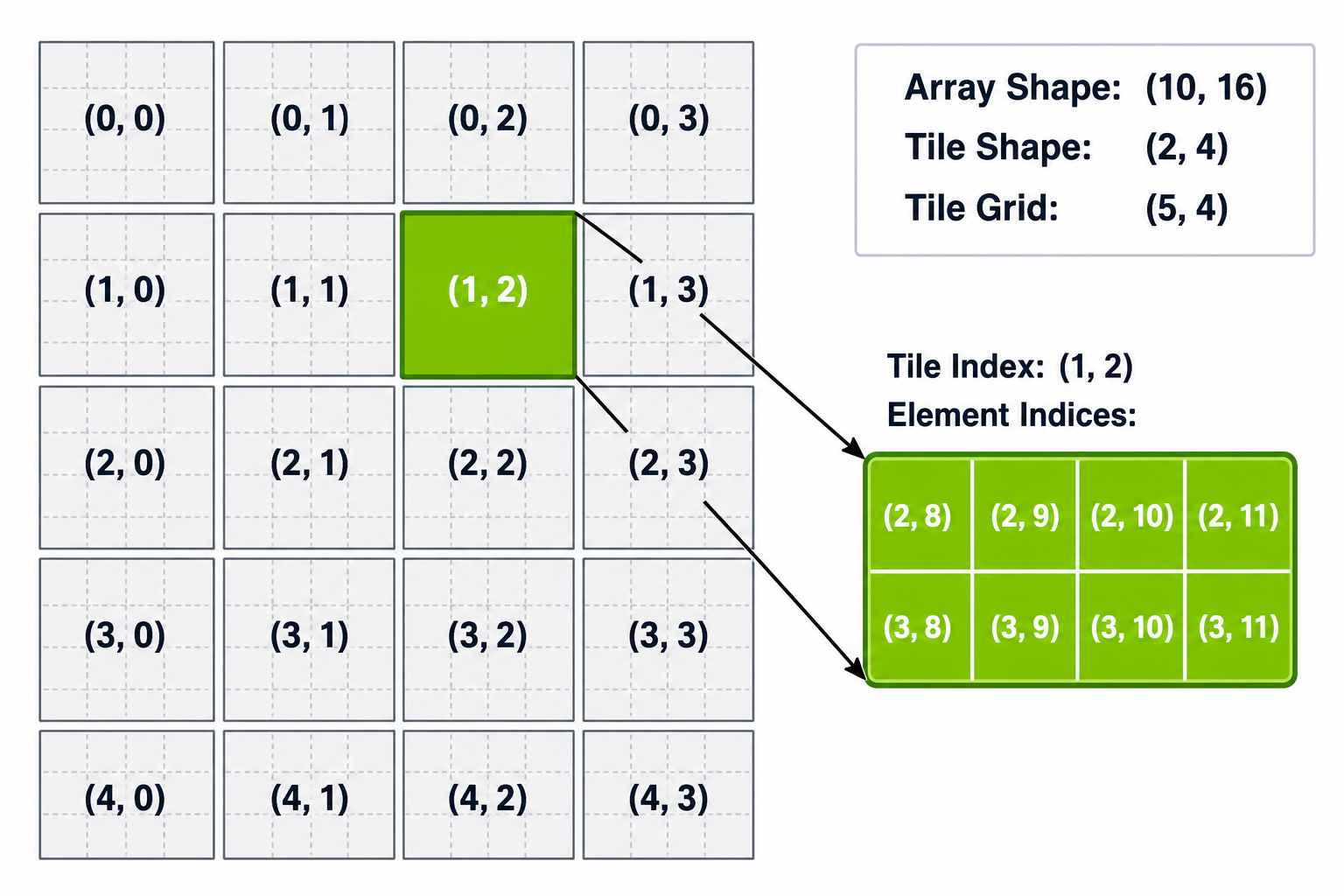
图 19:partition view 的 tile-space 索引。形状 (10, 16) 的数组按 (2, 4) tile 划分,得到 (5, 4) 的 tile grid。每格标注索引 (i, j);高亮的 (1, 2) 覆盖数组元素 (2, 8) 到 (3, 11)。
数组维度不能被 tile 大小整除时,边缘 tile 只有部分元素有效,见 边界处理。
Partition view 只是 tile-space 的一种;两种语言还支持:
- 固定形状、按指定步长排列的块,块间可有间隙或重叠。C++ 为
ct::strided_view,Python 为Array.tiled_view的traversal_steps参数。 - 按某个维度上的索引 tile 选择数据块,用于不规则访问。C++ 为
ct::gather_scatter_view,Python 为ct.load_advanced_indexing、ct.store_advanced_indexing。
本节只演示 partition view,它也是 Array.tiled_view 的默认结果。其他 view 详见各语言 API Reference。
2.4.6.1.1 Partition view 的 load/store
结构化 tile-space 访问是 global memory 与 tile 之间移动数据的首选方式。先构造 view,再用 tile-space 索引逐 tile 访问。
C++ 分为两步:
ct::tensor_span将原始指针与ct::extents结合,赋予多维结构。ct::partition_view将 span 划分为固定大小的 tile grid,提供.load(idx...)与.store(tile, idx...)。
Python 的 Array.tiled_view(tile_shape) 返回 TiledView,提供 .load(index)、.store(index, tile),与 C++ 的 partition view 对应。
注意
本节 C++ 指针使用 __restrict__,并在 kernel 前部调用 ct::assume_aligned(ptr, 16_ic),它们是重要的性能注解,见 C++ 性能建议。数字后的 _ic 表示 编译时常量。
C++:
__tile_global__ void vec_add(float* __restrict__ a, float* __restrict__ b, float* __restrict__ out) {
    namespace ct = cuda::tiles;
    using namespace ct::literals;
    a = ct::assume_aligned(a, 16_ic);
    b = ct::assume_aligned(b, 16_ic);
    out = ct::assume_aligned(out, 16_ic);
    // Step 1: attach a shape to each raw pointer. 128_ic marks 128 as a compile-time constant.
    auto aSpan = ct::tensor_span{a, ct::extents{128_ic}};
    auto bSpan = ct::tensor_span{b, ct::extents{128_ic}};
    auto oSpan = ct::tensor_span{out, ct::extents{128_ic}};
    // Step 2: partition each span into a tile space of fixed 8-element tiles.
    auto aView = ct::partition_view{aSpan, ct::shape{8_ic}};
    auto bView = ct::partition_view{bSpan, ct::shape{8_ic}};
    auto oView = ct::partition_view{oSpan, ct::shape{8_ic}};
    int bx = ct::bid().x; // this block's tile-space index along .x
    auto aTile = aView.load(bx); // pick the bx-th tile of a
    auto bTile = bView.load(bx);
    oView.store(aTile + bTile, bx); // write the tile back at the bx-th position of out
}
Python:
@ct.kernel
def vec_add(a, b, c, TILE: ct.Constant[int]):
    a_view = a.tiled_view((TILE,))
    b_view = b.tiled_view((TILE,))
    c_view = c.tiled_view((TILE,))
    bid = ct.bid(0)
    a_tile = a_view.load((bid,))
    b_tile = b_view.load((bid,))
    c_view.store((bid,), a_tile + b_tile)
2.4.6.1.2 Python 单次调用形式的 load/store
Python 还可以不显式创建 view,直接在每次操作中指定形状:ct.load(array, index, shape) 读取 tile,ct.store(array, index, tile) 写回。
它与 Array.tiled_view 表达相同的访问模式,差别只是 tile 形状绑定的位置:view 在创建时绑定一次,直接调用则每次指定。多次复用同一划分时优先使用 view;一次性的简单加载可直接调用。
@ct.kernel
def vec_add(a, b, c, TILE: ct.Constant[int]):
    bid = ct.bid(0) # this block's tile-space index along axis 0
    a_tile = ct.load(a, index=(bid,), shape=(TILE,)) # (index, shape) = pick the bid-th TILE-sized region of a
    b_tile = ct.load(b, index=(bid,), shape=(TILE,))
    ct.store(c, index=(bid,), tile=a_tile + b_tile) # write the tile back to the bid-th region of c
2.4.6.1.3 Tile-space 边界处理
C++ partition_view 提供 unmasked 与 masked 两种版本。
| 操作 | 边界行为 |
|---|---|
.load(idx...) / .store(tile, idx...) | 假定整个 tile 均在边界内;部分越界是未定义行为。 |
.load_masked(idx...) | 安全处理部分越界,默认补零,也可选择其他 padding,例如浮点 NaN。 |
.store_masked(tile, idx...) | 丢弃越界位置的写入。 |
数组能被 tile 完全整除时,优先使用 unmasked;需要处理边界时,masked 也可以用于完全有效的 tile。
这里的 C++ 示例首次使用运行时数组维度。ct::extents{N} 接受运行时值,也可以与 _ic 常量混合,使 span、partition view 描述 launch 时才确定大小的数组。
Python 的 ct.load 通过 padding_mode 决定越界位置的值:
PaddingMode.UNDETERMINED:默认值。仍执行边界检查,不会读取数组外 memory,但越界位置返回何值由实现决定。适用于这些位置永远不会被使用的情况。PaddingMode.ZERO:越界位置填零。
ct.store 无需 padding_mode,默认检查边界并丢弃越界写入。tiled_view 采用相同规则,并在创建 view 时固定 padding 模式。
ct.load、ct.store 还接受默认值为 True 的 check_bounds。Padding 决定越界位置的值,而 check_bounds 决定是否检查边界。设置为 False 后,越界可能读取或覆盖相邻 memory,属于未定义行为,相当于 C++ unmasked 形式。TiledView.load/store 也接受该参数。
C++:
__tile_global__ void edge_safe(float* __restrict__ in, float* __restrict__ out, int N) {
    namespace ct = cuda::tiles;
    using namespace ct::literals;
    in = ct::assume_aligned(in, 16_ic);
    out = ct::assume_aligned(out, 16_ic);
    // ct::extents{N} uses a runtime dimension; 128_ic stays compile-time.
    auto inView = ct::partition_view{ct::tensor_span{in, ct::extents{N}}, ct::shape{128_ic}};
    auto outView = ct::partition_view{ct::tensor_span{out, ct::extents{N}}, ct::shape{128_ic}};
    int bx = ct::bid().x;
    auto tile = inView.load_masked(bx); // masked load: OOB lanes default to 0
    outView.store_masked(tile, bx); // masked store: OOB writes silently discarded
}
Python:
@ct.kernel
def edge_safe(arr_in, arr_out, TILE: ct.Constant[int]):
    bid = ct.bid(0)
    tile = ct.load(arr_in, index=(bid,), shape=(TILE,),
                   padding_mode=ct.PaddingMode.ZERO) # OOB lanes of a partial edge tile become 0
    ct.store(arr_out, index=(bid,), tile=tile) # OOB writes are silently discarded
C++ 使用 .load_masked()、.store_masked() 处理边缘;Python load 使用零填充,store 默认丢弃越界写入。完整模式见各语言 API Reference。
边界范围
这里讨论的是部分越界的边缘 tile。加载或存储一个完全位于数组之外的 tile,原文规定为未定义行为。
2.4.6.2 Gather 与 scatter
Partition view 表达规则、对齐的数据划分。当访问取决于数据或不规则索引,例如查表、置换时,可用 gather/scatter 访问数组中非均匀、非连续的位置。
Python 使用索引 tile,传给 ct.gather()、ct.scatter(),默认带边界检查。C++ 使用指针 tile,传给 ct::load()、ct::store();masked 版本接收布尔 mask tile。
C++ 中,标量指针加整数 tile 会逐元素生成指针 tile,每个元素指向一个目标地址,是构造 gather/scatter 的常用方式。
Python 的 ct.gather 对各索引逐元素读取,越界默认补零,可通过 padding_value= 修改;ct.scatter 对各索引逐元素写入,丢弃越界写入。二者均可用 check_bounds=False 关闭检查。
C++:
__tile_global__ void vec_add_gather(int* __restrict__ a, int* __restrict__ b, int* __restrict__ out) {
    namespace ct = cuda::tiles;
    using namespace ct::literals;
    using i32x8 = ct::tile<int, ct::shape<8>>;
    a = ct::assume_aligned(a, 16_ic);
    b = ct::assume_aligned(b, 16_ic);
    out = ct::assume_aligned(out, 16_ic);
    int bx = ct::bid().x;
    auto offsets = 8 * bx + ct::iota<i32x8>(); // element-level offsets, one per lane
    // scalar pointer + int tile = tile of pointers (one pointer per offset).
    auto aPtrs = a + offsets;
    auto bPtrs = b + offsets;
    auto aTile = ct::load(aPtrs); // gather: one load per pointer
    auto bTile = ct::load(bPtrs);
    ct::store(out + offsets, aTile + bTile); // scatter: one store per pointer
}
Python:
@ct.kernel
def vec_add_gather(a, b, c, TILE: ct.Constant[int]):
    bid = ct.bid(0)
    indices = bid * TILE + ct.arange(TILE, dtype=ct.int32) # one element index per lane
    a_tile = ct.gather(a, indices) # load a[indices[i]] per lane
    b_tile = ct.gather(b, indices)
    ct.scatter(c, indices, a_tile + b_tile) # store one value per index into c
2.4.6.2.1 Gather/scatter 边界处理
Python 默认保证边界安全:越界读返回 padding,默认零;越界写丢弃。只有能证明全部索引有效时才应关闭检查,否则越界属于未定义行为。其他 mask、padding 参数见对应 API Reference。
C++ 不自动检查边界。程序员需要构造布尔 mask,例如比较 offset 与数组长度,再传给 ct::load_masked、ct::store_masked。
__tile_global__ void gather_safe(int* __restrict__ arr, int* __restrict__ out, int N) {
    namespace ct = cuda::tiles;
    using namespace ct::literals;
    using i32x8 = ct::tile<int, ct::shape<8>>;
    arr = ct::assume_aligned(arr, 16_ic);
    out = ct::assume_aligned(out, 16_ic);
    int bx = ct::bid().x;
    auto offsets = 8 * bx + ct::iota<i32x8>(); // element-level offsets, one per lane
    auto mask = offsets < N; // boolean tile: true where the offset is in-bounds
    auto ptrs = arr + offsets; // tile of pointers, one per offset
    auto tile = ct::load_masked(ptrs, mask, 0); // masked lanes get the pad value 0
    ct::store_masked(out + offsets, tile, mask); // masked lanes are skipped on the store
}
2.4.7 控制流
从程序员视角,每个 tile block 只有一条控制流路径。条件和循环边界由标量决定,循环体中的 tile 操作由编译器分配到硬件 thread。
并非所有控制流结构都受支持,例如不能从循环体内直接 return。完整限制见 CUDA Tile C++ general principles 和 cuTile Python control flow 文档。
2.4.7.1 循环
常见模式是依次处理数组中的多个 tile。C++ 的 ct::irange 表示从下界开始、到上界之前结束、具有可选步长的递增整数范围。通过 range-for 遍历它,可以将结构化边界信息提供给编译器以便优化;需要将循环变量直接绑定到该 range-for,相关优化才能生效。
Python 支持 range()、for、while 及嵌套循环。Range 的步长必须严格为正,不支持负步长。
以下 kernel 仅用一个 block,遍历并求和一维数组中的所有 tile。
C++:
__tile_global__ void tile_sum(float* __restrict__ arr, float* __restrict__ out, int num_tiles) {
    namespace ct = cuda::tiles;
    using namespace ct::literals;
    using f32x8 = ct::tile<float, ct::shape<8>>;
    arr = ct::assume_aligned(arr, 16_ic);
    out = ct::assume_aligned(out, 16_ic);
    auto inView = ct::partition_view{ct::tensor_span{arr, ct::extents{8 * num_tiles}},
                                      ct::shape{8_ic}};
    auto outView = ct::partition_view{ct::tensor_span{out, ct::extents{8_ic}},
                                      ct::shape{8_ic}};
    auto acc = ct::full<f32x8>(0.0f);
    // range-for over ct::irange gives the compiler structured iteration bounds.
    for (auto k : ct::irange(0, num_tiles)) {
        auto tile = inView.load(k);
        acc = acc + tile; // accumulate the k-th tile into acc
    }
    outView.store(acc, 0); // write the final result as the 0-th tile of out
}
Python:
@ct.kernel
def tile_sum(arr, out, TILE: ct.Constant[int], N_TILES: ct.Constant[int]):
    # Intended grid: (1,) -- a single block sums all tiles of arr.
    acc = ct.zeros((TILE,), dtype=ct.float32)
    for k in range(N_TILES): # range() works natively in tile code
        tile = ct.load(arr, index=(k,), shape=(TILE,))
        acc = acc + tile # accumulate the k-th tile into acc
    ct.store(out, index=(0,), tile=acc) # write the final result as the 0-th tile of out
2.4.7.2 条件语句
标准 if/else 可以正常使用。由于一个 block 只有单一控制流路径,不需要考虑 SIMT 中 warp 内的分支分歧。
C++:
__tile_global__ void conditional_load(float* __restrict__ arr, float* __restrict__ out, int N) {
    namespace ct = cuda::tiles;
    using namespace ct::literals;
    using f32x8 = ct::tile<float, ct::shape<8>>;
    arr = ct::assume_aligned(arr, 16_ic);
    out = ct::assume_aligned(out, 16_ic);
    auto inView = ct::partition_view{ct::tensor_span{arr, ct::extents{N}}, ct::shape{8_ic}};
    auto outView = ct::partition_view{ct::tensor_span{out, ct::extents{N}}, ct::shape{8_ic}};
    int bx = ct::bid().x;
    int nb_x = ct::num_blocks().x;
    auto tile = ct::full<f32x8>(0.0f); // default for the last-block branch
    // Scalar condition -> one control-flow path per block; no divergence to reason about.
    if (bx < nb_x - 1) {
        tile = inView.load(bx); // all blocks except the last
    }
    outView.store_masked(tile, bx); // masked to handle a potentially partial final tile
}
Python:
@ct.kernel
def conditional_load(arr, out, TILE: ct.Constant[int]):
    bid = ct.bid(0)
    # Scalar condition -> one control-flow path per block; no divergence to reason about.
    if bid < ct.num_blocks(0) - 1:
        tile = ct.load(arr, index=(bid,), shape=(TILE,)) # all blocks except the last
    else:
        tile = ct.zeros((TILE,), dtype=ct.float32) # last block: emit zeros
    ct.store(out, index=(bid,), tile=tile)
2.4.8 逐元素运算与 broadcasting
Tile 支持标准逐元素算术。两个操作数形状不同但兼容时,先 broadcast 到共同形状,再执行操作。
2.4.8.1 Broadcasting
规则与 NumPy 相同:标量复制到全部元素;长度为 1 的维度可扩展;低秩操作数按尾部维度对齐,缺少的前导维度视为 1。如果对应维度都不为 1 且大小不同,则操作无效。
下面同时演示维度提升与 singleton 扩展:8 × 2 先视作 1 × 8 × 2,再与 4 × 1 × 2 broadcast 到 4 × 8 × 2。
C++:
auto x = ct::iota<ct::tile<int, ct::shape<8, 2>>>(); // 8x2 (rank 2)
auto y = ct::iota<ct::tile<int, ct::shape<4, 1, 2>>>(); // 4x1x2 (rank 3)
auto z = x + y; // x promoted to 1x8x2, then broadcasts to 4x8x2
Python:
x = ct.full((8, 2), 3, dtype=ct.int32) # 8x2 (rank 2)
y = ct.full((4, 1, 2), 5, dtype=ct.int32) # 4x1x2 (rank 3)
z = x + y # x promoted to 1x8x2, then broadcasts to 4x8x2
2.4.8.2 算术运算符
支持的运算符均逐元素执行,产生 broadcast 后形状的新 tile。标量与 tile 组合时,标量扩展到每个元素。不同类型通常优先选择能保留更多信息的类型。
- Tile 与 tile:选择更高精度或更大范围的类型,例如
int + float得到float,int16 + int32得到int32。 - 标量与 tile:如果标量可直接由 tile 元素类型表示,例如整数
2与 int tile、2.0f与 float tile,则使用 tile 的类型。 - 如果标量需要窄化才能放入 tile 类型,例如
2.5与 int tile,Python 会提升到能同时容纳二者的类型,而 C++ 会将表达式判为无效。
C++:
using i32x8 = ct::tile<int, ct::shape<8>>;
i32x8 x = ct::full<i32x8>(3);
x + 2; // OK - int literal matches int tile element type
x + 2.5; // ill-formed - 2.5 would narrow to int
Python:
x = ct.full((8,), 3, dtype=ct.int32)
x + 2 # int32 - int literal matches int32 tile dtype
x + 2.5 # float32 - result promoted to hold both
实际编程时,尽量让标量字面量与 tile 元素类型一致,需要改变精度时显式转换。对加载得到的 tile 也采用相同规则。
C++:
__tile_global__ void elementwise(float* __restrict__ a, float* __restrict__ b, float* __restrict__ out, int N) {
    namespace ct = cuda::tiles;
    using namespace ct::literals;
    a = ct::assume_aligned(a, 16_ic);
    b = ct::assume_aligned(b, 16_ic);
    out = ct::assume_aligned(out, 16_ic);
    auto aView = ct::partition_view{ct::tensor_span{a, ct::extents{N}}, ct::shape{8_ic}};
    auto bView = ct::partition_view{ct::tensor_span{b, ct::extents{N}}, ct::shape{8_ic}};
    auto cView = ct::partition_view{ct::tensor_span{out, ct::extents{N}}, ct::shape{8_ic}};
    int bx = ct::bid().x;
    auto x = aView.load(bx);
    auto y = bView.load(bx);
    // 2.0f matches the float tiles' element type, so no narrowing conversion is required.
    // The scalar is broadcast across every element; + then runs elementwise.
    auto z = 2.0f * x + y;
    cView.store(z, bx);
}
Python:
@ct.kernel
def elementwise(a, b, c, TILE: ct.Constant[int]):
    bid = ct.bid(0)
    x = ct.load(a, index=(bid,), shape=(TILE,))
    y = ct.load(b, index=(bid,), shape=(TILE,))
    # 2.0 is a loosely typed float constant; with float tiles, the result stays float.
    # Scalars are broadcast across every element of the tile, then + runs elementwise.
    z = 2.0 * x + y
    ct.store(c, index=(bid,), tile=z)
需要显式控制舍入或 subnormal 行为时,可使用 tile API 提供的数学函数,包括逐元素 ct.add、ct::add,以及 exp、tanh 等超越函数。
2.4.9 Tile 原语
Factory、load/store、逐元素运算都是 tile 原语,即语言内置操作。程序员以 tile 粒度表达,编译器映射到硬件,适用时可使用 Tensor Core。本节介绍其他原语。
2.4.9.1 矩阵乘法
Tile 间矩阵乘法是实现数组矩阵乘法的基础。CUDA Tile 提供纯矩阵乘法 matmul,即 a @ b,以及乘加 mma,即 a @ b + acc。mma 的 accumulator 将前一个 K-tile 的部分结果传给下一个,适合分块矩阵乘法内循环。
两种操作支持二维矩阵乘法、三维 batched multiply,以及输入和 accumulator 采用不同精度。秩与类型限制见 API Reference。
下面采用常见模式:不论输入精度,使用 FP32 accumulator,store 时再转为输出类型。Python 使用 ct.mma(a, b, acc),C++ 使用 ct::mma(a, b, acc),且 acc 为 FP32。
K 循环次数为 ceil(K / tk),覆盖 A 的右边缘、B 的下边缘。部分有效的 K-tile 加载时补零:Python 使用 PaddingMode.ZERO,C++ 使用 .load_masked();C 的 M/N 边缘在 store 时丢弃越界写入。
C++:
__tile_global__ void gemm(const __half* __restrict__ A, const __half* __restrict__ B, float* __restrict__ C,
                          std::size_t M, std::size_t K, std::size_t N) {
    namespace ct = cuda::tiles;
    using namespace ct::literals;
    using f32_acc = ct::tile<float, ct::shape<32, 32>>;
    A = ct::assume_aligned(A, 16_ic);
    B = ct::assume_aligned(B, 16_ic);
    C = ct::assume_aligned(C, 16_ic);
    constexpr auto tm = 32_ic;
    constexpr auto tn = 32_ic;
    constexpr auto tk = 16_ic;
    auto aView = ct::partition_view{ct::tensor_span{A, ct::extents{M, K}}, ct::shape{tm, tk}};
    auto bView = ct::partition_view{ct::tensor_span{B, ct::extents{K, N}}, ct::shape{tk, tn}};
    auto cView = ct::partition_view{ct::tensor_span{C, ct::extents{M, N}}, ct::shape{tm, tn}};
    auto [bx, by, bz] = ct::bid();
    auto acc = ct::full<f32_acc>(0.0f); // FP32 accumulator
    std::size_t num_k = (K + tk - 1) / tk;
    for (auto k : ct::irange(std::size_t{0}, num_k)) {
        acc = ct::mma(aView.load_masked(bx, k), // zero-pad partial K-tile
                      bView.load_masked(k, by),
                      acc); // acc += a @ b
    }
    cView.store_masked(acc, bx, by); // drop OOB edge lanes
}
Python:
@ct.kernel
def gemm(A, B, C,
         tm: ct.Constant[int], tn: ct.Constant[int], tk: ct.Constant[int]):
    bx, by = ct.bid(0), ct.bid(1)
    num_k = ct.num_tiles(A, axis=1, shape=(tm, tk)) # number of K-tiles
    acc = ct.full((tm, tn), 0, dtype=ct.float32) # FP32 accumulator
    for k in range(num_k):
        a = ct.load(A, index=(bx, k), shape=(tm, tk),
                    padding_mode=ct.PaddingMode.ZERO) # zero-pad partial K-tile
        b = ct.load(B, index=(k, by), shape=(tk, tn),
                    padding_mode=ct.PaddingMode.ZERO)
        acc = ct.mma(a, b, acc) # acc += a @ b
    ct.store(C, index=(bx, by), tile=acc.astype(C.dtype)) # cast + store
2.4.9.2 Reduction 与 scan
Reduction 将 tile 沿一个或多个轴归约为标量或一组标量,例如 softmax 分母、LayerNorm 的均值方差、attention score 中的最大值。
需要注意输出形状:Python 默认删除被归约轴,可用 keepdims=True 保留为长度 1;C++ 总是保留该轴,因此 tile 秩不变。下面都对 2 × 4 tile 沿 axis 1 归约,但输出形状不同。
C++:
using namespace ct::literals;
using i32x2x4 = ct::tile<int, ct::shape<2, 4>>;
auto x = ct::iota<i32x2x4>(); // [[0,1,2,3],[4,5,6,7]]
auto row_sums = ct::sum(x, 1_ic); // shape (2, 1) - axis kept
// row_sums == [[6], [22]]
Python:
x = ct.arange(8, dtype=ct.int32).reshape((2, 4)) # [[0,1,2,3],[4,5,6,7]]
s = ct.sum(x, axis=1) # shape (2,) - axis dropped
s_k = ct.sum(x, axis=1, keepdims=True) # shape (2, 1) - axis kept
# s == [6, 22]; s_k == [[6], [22]]
Scan 是沿轴累积的对应操作。例如 prefix sum(cumsum)输出与输入维度相同,每个位置保存到该位置为止的前缀和。完整操作见各语言 reduction 与 scan API 文档。
2.4.9.3 Transpose 与 permutation
这两类原语改变 tile 的轴排列:transpose 交换轴,permute 指定任意排列。它们用于矩阵乘操作数转置、attention block 的行列交换,或在 broadcast 前对齐各轴。
Python 对二维 tile 调用 ct.transpose(x) 交换两轴,更高维时显式指定 axis0、axis1;ct.permute(x, axes) 接受轴索引 tuple。
C++ 的 ct::transpose(x) 交换前两维,保留后续维度;ct::permute(x, map) 用 ct::dimension_map 描述新顺序。
C++:
using namespace ct::literals;
using t2d = ct::tile<int, ct::shape<2, 4>>;
using t3d = ct::tile<int, ct::shape<2, 2, 2>>;
auto tx = ct::iota<t2d>();
auto ty = ct::transpose(tx); // shape (4, 2)
auto tz = ct::iota<t3d>();
auto tw = ct::permute(tz, ct::dimension_map{2_ic, 0_ic, 1_ic}); // axes (0,1,2) -> (2,0,1)
Python:
tx = ct.arange(8, dtype=ct.int32).reshape((2, 4))
ty = ct.transpose(tx) # shape (4, 2)
tz = ct.arange(8, dtype=ct.int32).reshape((2, 2, 2))
tw = ct.permute(tz, (2, 0, 1)) # axes (0,1,2) -> (2,0,1)
2.4.9.4 逐元素选择
给定布尔 tile 和两个数据 tile,根据对应布尔值逐元素选择结果。条件可 broadcast 到操作数形状,两个数据操作数的类型须兼容。
Python 使用 ct.where(cond, x, y);C++ 使用 ct::select(cond, lhs, rhs)。
C++:
using namespace ct::literals;
auto cond = ct::iota<ct::tile<int, ct::shape<4>>>() < 2; // {T, T, F, F}
auto t = ct::full<ct::tile<float, ct::shape<4>>>( 1.0f);
auto f = ct::full<ct::tile<float, ct::shape<4>>>(-1.0f);
auto r = ct::select(cond, t, f); // {1, 1, -1, -1}
Python:
cond = ct.arange(4, dtype=ct.int32) < 2 # [T, T, F, F]
x_true = ct.full((4,), 1.0, dtype=ct.float32)
x_false = ct.full((4,), -1.0, dtype=ct.float32)
result = ct.where(cond, x_true, x_false) # [1, 1, -1, -1]
2.4.9.5 数学函数
ct 命名空间提供以下常见逐元素操作:
| 类别 | 函数 |
|---|---|
| 基本算术 | add、sub、mul |
| 除法与取模 | truediv、floordiv、cdiv、mod |
| 幂、指数、对数 | pow、exp、exp2、log、log2 |
| 平方根 | sqrt、rsqrt |
| 三角函数 | sin、cos、tan |
| 双曲函数 | sinh、cosh、tanh |
| 比较与取负 | minimum、maximum、negative |
| 取整 | floor、ceil |
函数逐元素处理输入 tile 并返回相应形状的 tile,也可在 tile code 中处理标量。精确规则和完整列表见 cuTile Python Math Operations、CUDA Tile C++ Math Operations。
2.4.10 Atomic memory 操作
Tile code 中,常见的 atomic 需求有两种:不同 block 将部分结果合并到同一 global memory 地址;或同一 tile 的多个元素写入同一地址。
对 tile 执行一次 atomic 调用,会为每个元素执行一次 atomic update。单个元素更新是原子的,整个 tile 调用并不是一个整体原子操作。 各元素操作顺序未指定。
Python 通过 array 索引寻址,规则与 gather/scatter 相同。可选参数控制边界检查、memory order、thread scope,默认启用边界检查,采用 ACQ_REL 和 device scope。
TiledView 还提供 atomic_store_ 开头的方法,例如 atomic_store_add(index, update),使用 tile-space 索引,不返回旧值,并可生成 PTX atomic reduction。不需要旧值时,优先使用它以提升性能。
C++ 自由函数接收标量指针与标量值,或指针 tile 与数值 tile。Memory order 通过编译时类型标签指定,例如 ct::memory_order_relaxed_t{};thread scope 也使用类型标签,省略时默认为 system scope。
ct::partition_view、ct::strided_view 还提供 atomic_add、atomic_sub、atomic_and、atomic_or、atomic_xor、atomic_max、atomic_min 成员函数。与 .store() 一样,value tile 在前,tile-space 索引在后。它们不返回旧值,可生成硬件 reduction;不需要旧值时应优先使用。ct::gather_scatter_view 不提供这些成员。
2.4.10.1 跨 block 竞争
下面不同 block 写入同一 out 地址,若不使用 atomic,并行更新将产生错误。C++ 显式使用 ct::thread_scope_device_t{},Python 默认 device scope,使更新对所有 block 可见。
Python 使用 TiledView.atomic_store_add,因为只需要将每个 block 的部分和累加到 out[0],不需要返回旧值。
C++:
__tile_global__ void block_sum(int* __restrict__ arr, int* __restrict__ out, std::size_t N) {
    namespace ct = cuda::tiles;
    using namespace ct::literals;
    constexpr auto TILE = 16_ic;
    arr = ct::assume_aligned(arr, 16_ic);
    out = ct::assume_aligned(out, 16_ic);
    auto aView = ct::partition_view{ct::tensor_span{arr, ct::extents{N}},
                                    ct::shape{TILE}};
    int bid = ct::bid().x;
    auto tile = aView.load_masked(bid); // partial final tile -> OOB lanes default to 0
    auto partial = ct::sum(tile, 0_ic); // reduce to a 1-element tile
    ct::atomic_add(out, (int)partial, // accumulate the scalar into out[0]
                   ct::memory_order_relaxed_t{}, // single-location accumulator -> relaxed suffices
                   ct::thread_scope_device_t{}); // visible across the device
}
Python:
@ct.kernel
def block_sum(arr, out, TILE: ct.Constant[int]):
    bid = ct.bid(0)
    # partial final tile -> OOB lanes default to 0
    tile = ct.load(arr, index=(bid,), shape=(TILE,),
                      padding_mode=ct.PaddingMode.ZERO)
    partial = ct.sum(tile) # reduce to a scalar
    out.tiled_view((1,)).atomic_store_add((0,), partial) # atomically accumulate into out[0]
2.4.10.2 block 内竞争
下面一个 tile 的所有元素原子累加到同一个 slot 地址。ptrs 中每个指针都指向同一位置,ct::iota<i32x16>() 的每个元素分别执行 atomic add,顺序未指定。
使用 ct::thread_scope_block_t{},表示只需要 block 内的原子可见性范围。
using i32x16 = ct::tile<int, ct::shape<16>>;
int* slot = /* pointer to the contended location */;
// 16 lanes all aim at the same address. Add is commutative, so the
// unspecified ordering doesn't affect this sum; block scope suffices
// since contention stays within one block.
auto ptrs = ct::full<ct::tile<int*, ct::shape<16>>>(slot);
ct::atomic_add(ptrs, ct::iota<i32x16>(),
            ct::memory_order_relaxed_t{},
            ct::thread_scope_block_t{});
注意
这只是说明性示例。若只是将 block 内一个 tile 求和为标量,应优先使用 reduction。
2.4.10.3 支持的 atomic 操作
| 操作 | 作用 |
|---|---|
atomic_and / atomic_or / atomic_xor | 与 memory 旧值逐元素执行按位与、或、异或。 |
atomic_max / atomic_min | 比较传入值与旧值,写入较大值或较小值。 |
atomic_add | 累加并写回。 |
atomic_sub | 减去传入值并写回,仅 C++ 提供此名称。 |
atomic_xchg | 写入新值并返回旧值。 |
atomic_cas | 比较旧值与 expected,相等时替换为 desired;C++ 名称为 atomic_compare_exchange。 |
完整说明见两种语言 API Reference 的 memory operation 部分。
2.4.11 优化 hint
Hint 是附着在 kernel 或特定 load/store 调用处的元数据,用于引导编译器生成代码。它不改变程序语义,可以添加、移除或调节而不影响正确性,编译器也可以忽略它。
Hint 具有两个共同特征:只作用于所附着的特定结构,不作用于周围所有代码;可以按 GPU 架构分别配置,也可以为全部架构指定统一值。
C++ 使用 attribute,Python 使用 kernel decorator 和 memory 调用上的关键字参数。两种语言的 hint 种类及含义相同,见 Hint 类型。
2.4.11.1 C++ 的 cutile::hint attribute
语法如下:
[[ cutile::hint(arch, kind1=value1, kind2=value2, ...) ]]第一个参数是目标架构整数,采用 __CUDA_ARCH__ 的编码规则,例如 900 表示 sm_90、1000 表示 sm_100;0 表示所有架构。其余参数为 kind=value。
Kernel hint 放在函数声明上;ct::load、ct::store、partition view 等 memory 操作的 hint,放在包含调用的表达式语句前。其他位置的规则见 API 文档。
下面为 sm_90、sm_100 指定不同 num_cta_in_cga,并将某次 load 标记为较重的 memory 流量。
[[ cutile::hint(900, num_cta_in_cga=4), // sm_90: prefer 4 CTAs per cluster
   cutile::hint(1000, num_cta_in_cga=8) ]] // sm_100: prefer 8 CTAs per cluster
__tile_global__ void optimization_hints(float* __restrict__ in,
                                        float* __restrict__ out) {
    namespace ct = cuda::tiles;
    using namespace ct::literals;
    in = ct::assume_aligned(in, 16_ic);
    out = ct::assume_aligned(out, 16_ic);
    auto inSpan = ct::tensor_span{in, ct::extents{128_ic}};
    auto outSpan = ct::tensor_span{out, ct::extents{128_ic}};
    auto inView = ct::partition_view{inSpan, ct::shape{8_ic}};
    auto outView = ct::partition_view{outSpan, ct::shape{8_ic}};
    int bx = ct::bid().x;
    // Expression-statement hint: tag this particular load as bandwidth-heavy.
    ct::tile<float, ct::shape<8>> tile;
    [[ cutile::hint(0, latency=8) ]]
    tile = inView.load(bx);
    outView.store(tile, bx);
}
同一结构上同类 hint 同时存在时,特定架构配置优先于通用配置。
2.4.11.2 Python decorator 参数与调用关键字
Python 的 kernel 级 hint 是 @ct.kernel(...) 的关键字参数。已编译 kernel 还提供 .replace_hints(**hints),返回采用新 hint 的 kernel,并具有自己的 JIT cache,适合作为 autotuning 循环的基础。
单次调用 hint 则放在 ct.load/store、TiledView.load/store、ct.gather/scatter 等调用处。
按架构指定时使用 cuda.tile.ByTarget(default=..., sm_XXX=..., sm_YYY=...),架构名如 sm_100、sm_120。普通值则适用于所有目标,相当于 C++ 的 arch=0。
下面对应前面的 C++ 示例:ByTarget 承载 kernel hint,latency=8 设置特定调用,replace_hints 无需修改源代码即可生成另一配置。
@ct.kernel(num_ctas=ByTarget(sm_90=4, sm_100=8))
def optimization_hints(in_, out, TILE: ct.Constant[int]):
    bid = ct.bid(0)
    # Per-call hint: this particular load is bandwidth-heavy.
    tile = ct.load(in_, index=(bid,), shape=(TILE,), latency=8)
    ct.store(out, index=(bid,), tile=tile)
# Autotuning: produce a new kernel with overridden hints without editing the
# source. The new kernel has its own JIT cache.
tuned_kernel = optimization_hints.replace_hints(num_ctas=8)
2.4.11.3 Hint 类型
以下 hint 在两种语言中含义和取值一致,只是部分名称不同。
2.4.11.3.1 每个 cluster 的 CTA 数
- C++:kernel attribute
num_cta_in_cga。 - Python:
@ct.kernel的num_ctas。 - 取值:
1、2、4、8、16;sm_80仅可使用1。 - 含义:建议 kernel 的每个 Cooperative Group Array(CGA)包含多少 Cooperative Thread Array(CTA)。
2.4.11.3.2 Occupancy
- 两种语言都使用
occupancy,位于 kernel 级。 - 取值:闭区间
[1, 32]的整数。 - 含义:建议每个 SM 的活跃 CTA 数量。编译器在代码生成时尽量满足,属于建议而非保证。
2.4.11.3.3 Memory access latency
- 两种语言均为
latency。C++ 放在调用所在表达式语句上,Python 放在调用关键字参数中。 - 适用于 tile-space load/store 与 gather/scatter。
- 取值为
[1, 10]的整数,1 表示轻 DRAM 流量,10 表示重流量。较大值通常使编译器采用更深的 prefetch。
2.4.11.3.4 允许 TMA
- 两种语言均为
allow_tma。 - 仅适用于 tile-space load/store,不适用于 gather/scatter。
- 取值为布尔值。默认允许 TMA;设为
false或False,可要求编译器不要把该次访问映射到 TMA。
2.4.12 C++ 性能建议
本节说明前面 C++ 示例常用的注解与编程模式,以及它们对性能的影响。
2.4.12.1 对 memory 中的数组使用 restrict 指针
__restrict__ 告诉编译器,在该指针有效期间,通过它访问的区域不会通过其他独立指针别名访问,详见 restrict 指针。满足条件并正确标记,对 tile C++ 的 memory 操作性能很重要。
考虑没有 __restrict__ 的逐元素复制:
__tile_global__ void tile_elementwise_copy(float* out, float const* in) {
    namespace ct = cuda::tiles;
    using f32x64 = ct::tile<float, ct::shape<64>>;
    using i32x64 = ct::tile<int, ct::shape<64>>;
    auto inPtrs = in + 64 * ct::bid().x + ct::iota<i32x64>();
    auto outPtrs = out + 64 * ct::bid().x + ct::iota<i32x64>();
    auto data = ct::load(inPtrs); // (1)
    ct::store(outPtrs, data); // (2)
}
通常无需关心编译器如何并行化 tile,但这里可以看出不重叠数组的优势:输入、输出互不重叠时,load 可拆为独立读取,store 只依赖自己使用的数据已经读取完成,因此读写可交错。
若输入、输出可能重叠,编译器必须先完成整个 tile 的所有 load,再发出任何 store,以免提前覆盖尚未读取的数据。这会限制调度优化。
因此,使用不重叠数组,并通过 __restrict__ 告知编译器,有助于生成更高效代码;错误地对具有别名访问的区域作此承诺,会导致未定义行为。
2.4.12.2 将数组指针标记为 16 字节对齐
使用 ct::assume_aligned:
__tile_global__ void foo(float* __restrict__ in) {
    namespace ct = cuda::tiles;
    using namespace ct::literals;
    in = ct::assume_aligned(in, 16_ic);
    ct::tensor_span t{in, ct::extents{256_ic, 256_ic}};
    ct::partition_view{t, ct::shape{4_ic, 4_ic}};
    // ...
}
这是 ct::partition_view 使用 TMA 的必要对齐保证。运行时必须确实提供 16 字节对齐的指针,否则是未定义行为。cudaMalloc 等 CUDA allocator 返回的指针保证至少满足这一对齐。
2.4.12.3 优先使用 ct::partition_view 访问 memory
对于结构化访问,优先使用 ct::partition_view,而非 gather/scatter 形式的 ct::load、ct::store。View 形式可在支持的硬件上映射到 TMA,通常比逐元素 gather 更快。相关背景见 Gather 与 scatter。
2.4.12.4 有界循环使用 ct::irange
遍历确定范围时,优先使用 ct::irange 而不是普通整数 for。结构化范围让编译器更容易进行 pipelining、vectorization 等优化;边界与步长只是难以分析的整数表达式时,无法获得同样的信息,见 控制流。
for (auto idx : ct::irange(lowerBound, upperBound, step)) {
    // ...
}